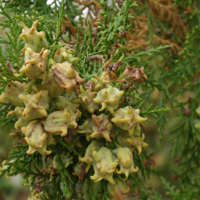
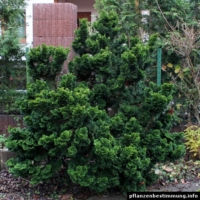
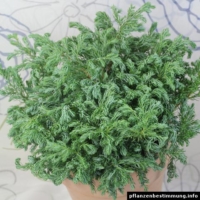
The Chinese juniper (Juniperus chinensis) is variable in its habitus. It can grow as a tree or shrub, upright or flat, and the leaves can look like needles or scales. Cultivated forms with yellow or yellow-green leaves are also available.
Growing wild, this member of the Cupressaceae family can reach more than 20 meters in height. However, the flat-growing forms and varieties remain smaller. They are well suited for cultivation in containers or large balcony planters.

Lighting
Growing in the garden, the Chinese juniper tolerates full sun. As a container plant, however, it is better if it is not exposed to the hot summer sun. Otherwise the root ball can dry out quickly. Semi-shady to partially sunny locations with early morning sun or late evening sun (after 7 p.m. in midsummer) are more suitable.

Soil
I use a mix of peat-free vegetable soil and pumice gravel or lava gravel. These porous types of gravel store up to 30% of their own weight in water. Standard substrates for potted plants, houseplants or bonsai can also be used.
Watering
The substrate must always be kept slightly moist. The surface may dry out moderately, but the root ball should not dry out.
Frozen soil can also dry out, which is why it can be helpful in harsh regions with long periods of frost if the Chinese juniper is allowed to spend this time in a cool but frost-free spot.

Fertilizing
Less is more, it is enough to start fertilizing one year after purchase or repotting.
Liquid fertilizers can be applied monthly from spring to late summer. Slow-release fertilizers such as sticks, granules or pellets only in spring.
Fertilizing sparingly helps to keep Juniperus chinensis small so that it does not “blow up” the pot or balcony planter after a short time.
Overwintering
The Chinese juniper is also hardy in balcony planters or containers and should tolerate frost down to at least 5 °F (-15 °C). Here in the region, it rarely or never gets that cold, which is why I cannot back up this statement with my own experience.
To prevent the drying out of leaves and branches in winter, Juniperus chinensis should be protected from frost without snow cover. When the root ball in the pot freezes during sub-zero temperatures and the sun shines during the day, the shoots may thaw and attempt to draw water from still-frozen roots. This does not work and can lead to the dieback of individual shoots or even the entire plant.
Juniperus × pfitzeriana (Pfitzer juniper)
The Pfitzer juniper (Juniperus × pfitzeriana) is a naturally occurring hybrid of the Chinese juniper (Juniperus chinensis) and the savin juniper (Juniperus sabina). It grows rather flat and can be cultivated as described in this article.

Categories: Shrubs & Trees |