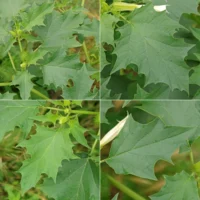
Leaf type: Oval, rhomboid, with a notched tip
Leaf margin: Smooth
Phyllotaxis: Alternate
Colour: Green, wine-red
Life cycle: Alternate
Leaf (upper side)


Growth habit & biology
Amaranthus blitum is an annual plant that can grow up to one metre tall or spread to about one metre across. Its appearance is quite variable. The stems may be upright, ascending, or lie flat along the ground. They can be green or reddish.
Amaranthus blitum can be distinguished from other Amaranthus species by its leaves, which have a heart-shaped notch at the tip. The leaves range from oval to slightly rhomboid in shape, and not all of them have a notched tip.
The leaves are usually green, but can occasionally be wine-red.


Distribution & habitates
Information regarding the native range of Amaranthus blitum is contradictory. While KEW considers the species to be native to South America, parts of the botanical literature assign its native range to the Mediterranean region and Central Europe.

I’ve only seen Amaranthus blitum in urban settings. In my neighborhood, it grows in sunny to partially shaded locations, in front of walls, in paving joints, and along roadsides.


Botany
Amaranthus blitum belongs to the amaranth family (Amaranthaceae). There are several subspecies (“subsp.”), the photos in this article show Amaranthus blitum subsp. pseudogracilis.
Common names include livid amaranth, purple amaranth, slender amaranth or Guernsey pigweed.